
Understanding the value of biodiversity in forest ecosystems
Biodiversity in forests is not just about having lots of plants and animals. It’s an essential component in how these systems function, remain resilient, and recover from distress. In forests rich in biodiversity, these diverse plants, fungi, insects, birds, and animals all fulfill unique functions that maintain the system’s resilience, solidity, and usefulness for humans and the natural world.
Biodiversity makes forests more resilient. The more variety there is in tree and undergrowth species, the lower the possibility that any one pest or disease could devastate an entire forest. For instance, if a bug attacks one tree species, more diverse forests lose fewer trees. This diversity aids forests in dealing with weather fluctuations. Following a storm or drought, some species come back quicker than others. This allows the forest to recover and prevents it from disintegrating. Research from both tropical and temperate forests, including those in Brazil and Germany, demonstrates how more diverse systems withstand storms and heat waves better than their single species counterparts.
Diverse forests are more efficient at cycling important nutrients and cultivating robust soil. Each species contributes different things to the soil. Certain trees drop nitrogen-rich leaves while others break down hardy cellulose. Fungi and bacteria living among the roots assist with liberating nutrients, making them more accessible to plants. These rhythms prevent the soil from becoming depleted and support robust tree growth. Mixed forests typically have more carbon in their soils and denser organic layers. That reduces the demand for external fertilizers, which makes management both more affordable and more environmentally friendly.
Forests with lots of species preserve water quality and purify our air. Tree roots anchor soil, preventing it from eroding into the streams. Plants absorb rainwater, which slows floods and replenishes groundwater. Leaves trap dust and absorb pollutants in the air, and trees can sequester carbon to mitigate climate change. Indonesia and Canada’s forests, with their mega-diverse trees, have a huge role in preserving water for local towns and cities. The same applies to air, where wide-leafed species can filter more particles than pine or fir stands.
Greater biodiversity leads to more habitat and food for wildlife. Each plant and tree provides habitat or food for birds, insects, and other animals. Forests with a diversity of large old trees, young saplings, fallen logs, and dense undergrowth sustain a greater number of species simultaneously. This is obvious in regions such as the Congo Basin, where aged forests full of diverse flora serve as a refuge for endangered gorillas, elephants, and numerous insect species. Even in smaller managed forests, every additional kind of plant attracts more pollinators, seed spreaders, and pest-controlling predators.
Key elements of a biodiverse forest environment
A biodiverse forest combines numerous species of flora and fauna, mature and young trees, living and decaying wood. All these components operate in harmony to maintain fertile ground, nurture flora and fauna, and sustain nature’s vital cycles. A good forest plan must align these layers and parts with the requirements of the land and its peoples.
Multi-layered canopies
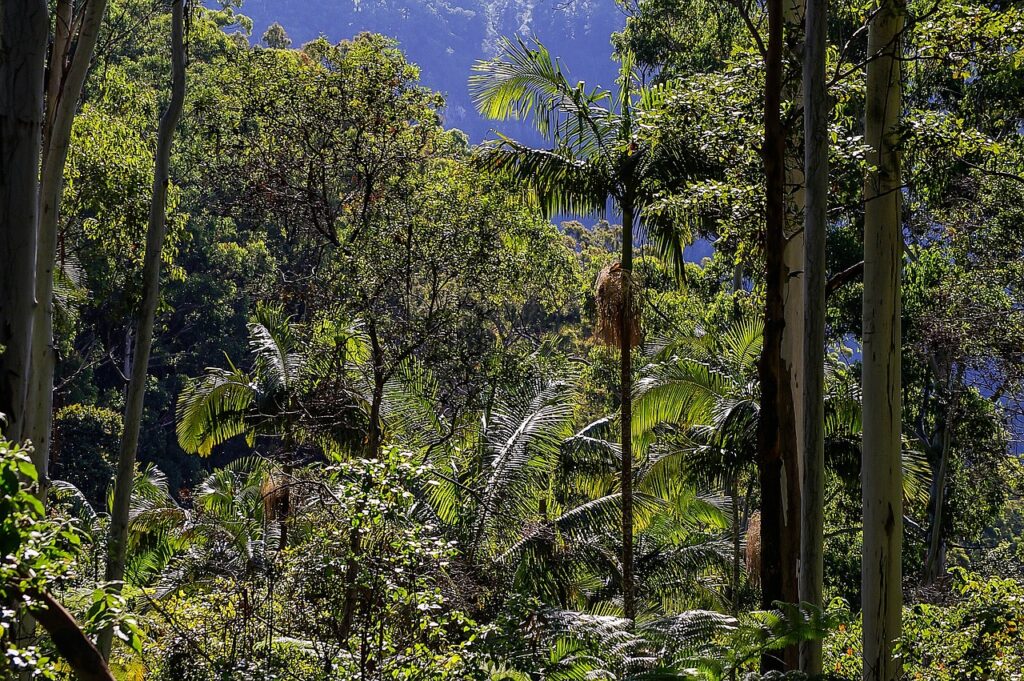
Multi-layered forests—understory, midstory, and overstory—provide additional habitats for wildlife. The overstory consists of large, tall trees that provide shade and assist in water retention in the soil. The midstory has small trees and big shrubs that fill in the open spaces and add more diversity of leaves and food. The understory houses small plants, saplings, and ground cover such as ferns and wildflowers. Each layer attracts different insects, birds, and animals. For example, overstory nesting birds require tall, mature trees, while frogs and insects may inhabit dense understory growth. Diversity of tree ages—old, mature, and young—provides habitats for different species. Even the most biodiverse forest with a single species of tree, a forest consisting of just one age of tree, supports far fewer animals.
Native plant species
Selecting natives is the secret to a well-rounded forest. Native trees, shrubs, and wildflowers have coevolved with the local climate and animals for millennia. They provide sustenance and habitat for local insects, birds, and mammals. Many insects and birds will only utilize specific native plants for food or nesting. By including many native species, the forest is better equipped to withstand changing weather, pests, or disease. For instance, a patch of native oaks, maples, and pines will harbor more birds and mammals than a plantation with a single species of fast-growing tree for timber. Planting just one kind to increase wood output may damage the entire forest ecosystem and may displace rare flora and fauna.
Deadwood, fallen logs, and snags
Dead trees, logs, and old stumps can appear untidy. They are an essential component of a robust forest ecosystem. These “legacy structures” house beetles, ants, fungi, and moss. Small mammals use them to hide or build nests. Woodpeckers and other birds excavate egg nests in snags. When logs rot, they nourish the earth and support saplings. After any harvest, leaving snags and logs behind will sustain these life cycles. Forests that sweep clean all deadwood shed a significant portion of their secret vitality.
Natural features and water
Streams, wetlands, and clearings add even further diversity. Open spaces such as meadows or ponds allow sunlight to reach the ground and support the growth of wildflowers and grasses. These pockets attract bees, butterflies, and grazers. Riparian zones, the areas adjacent to streams and rivers, are unique habitats for frogs, fish, and birds. Maintaining riparian buffers of native trees and vegetation along these banks protects water quality and prevents soil erosion. They help maintain the water cycle by allowing rain to percolate, which decreases flooding and keeps springs and streams flowing year-round.
Designing forests for maximum biodiversity
To design forests for biodiversity is to create a landscape that contains multiple types of habitats, not a single variety. It’s about mixing big forest patches with lots of little ones and adding green corridors connecting them. These actions assist flora and fauna to migrate and flourish. How trees and shrubs are selected and planted defines the forest’s structure and impacts everything from soil health to bird species.
It takes a mix of tree and shrub species to construct good structure. That means selecting species that grow at various heights, have different lifespans, and have diverse forms. Some trees form tall canopies, while others occupy the mid and understory layers. Shrubs and young trees blanket the forest floor. When these layers stack, they provide habitat and sustenance to an even greater amount of wildlife. For instance, in temperate forests, oaks, maples, and birch might cohabitate with hazel shrubs and wildflowers. In the tropics, giant dipterocarps, palms, and thick undergrowth add even more layers. A rich mix of species makes forests better able to withstand pests and diseases. Each plant contributes its own worth: some that nourish the birds, others that grip the soil, and still others that protect seedlings from the sun.
Planting layouts are important. Designing forests for maximum biodiversity is essential. Natural forests don’t grow in straight lines, so designs that mimic these patterns tend to do better for wildlife. Avoiding blocks of a single species or monocultures is the trick. Instead, clusters of trees are distributed and openings are maintained for sunshine and regeneration. In certain areas, such as ancient European woodlands, trees both young and ancient thrive together while fallen timber remains on the forest floor to nourish bugs and mushrooms. This diversity mix helps keep the ecosystem healthy and stable. Various layouts can sustain various creatures, including thickets for cover-loving birds, open areas for deer, and edges for pollinators.
Buffer zones and wildlife corridors connect fragmented habitats, allowing animals to migrate securely from one to another. Corridors, which are strips of trees by rivers or hedgerows between fields, provide animals with routes to migrate, forage, and mate. For big mammals, land bridges over roads or tunnels under highways can minimize roadkill and maintain population connectivity. Buffer zones, established between forest and farmland, filter out chemical and sound pollution and provide additional space for wildlife. Our research reveals that about 10% of forest cover should be in large patches, with 30% in small patches and connecting elements. At least 40% of total forest cover is often required, even more in the tropics. Global initiatives such as the Kunming-Montreal Global Biodiversity Framework target preserving these areas and maintaining their connectivity.
Management diversity is employing multiple methods of forest management. This could involve allowing certain spots to grow untamed, felling trees in others, and filling the voids with new growth. Five ideas guide this: keeping lots of habitats, making change over space and time, mixing patches together, copying natural forests, and making temporary corridors. They all help wildlife in various ways, and that mix is what matters.
| Planting Design | Key Features | Biodiversity Benefit |
| Mixed Species | Different tree/shrub types, ages, and heights | Supports many animal and plant species |
| Irregular Patterns | Natural groupings, gaps, and layers | Boosts microhabitat variety |
| Wildlife Corridors | Linked strips/paths between patches | Allows safe movement for many species |
| Buffer Zones | Extra border space, often with native plants | Shields core forest, supports edge species |
| Mosaic Layout | Mix of large patches, small patches, and corridors | Increases habitat choices and ecosystem links |
Practical management strategies for biodiversity enhancement
Planning and managing a forest for biodiversity requires thoughtful decisions and consistent effort. Monoculture plantations, where only one species of tree grows, can reduce plant and animal diversity. Sustainable management steps in to keep forests robust, nurture biodiversity, and reduce the impact of massive wildfires or droughts. These concepts are general and can apply to any climate and location.
Plan strategic thinning and burns to maintain proper sun and shade. Thinning involves deciding which trees to remove to let young ones and undergrowth plants have more light and room. Prescribed burns, conducted by expert crews, eliminate brush, dead wood and weeds that might feed wildfires. It recycles nutrients back into the ground and prevents invasive species from dominating. They discover that forests have far more species if they are regularly burned and thinned and are less susceptible to giant fires.
Safeguard emerging saplings with guards or mulch. Those little trees are sitting targets for deer and other critters. Simple fences or tubes around saplings prevent animals from browsing them. Mulching, or putting down a layer of wood chips or leaves around the base, helps keep the soil moist and prevents weeds from encroaching. These measures provide saplings with the best chance for survival and keep the forest a mixture of old and new trees.
Promote natural re-growth by leaving seed trees and minimizing ground disturbance when logging or clearing. If you leave a few viable mature trees, they will drop seeds for future generations. If workers shun heavy machines and do not rake up the ground too much, seeds and roots remain unharmed. This maintains the soil in a healthy state and allows many native species to return without intervention. Reforestation, or replacing trees after logging, disease, or fire, is yet another necessary action, particularly when undertaken with a mix of native species rather than monoculture.
Active stewardship allows you to increase and monitor a forest’s biodiversity value. A checklist for regular care might look like this:
- Examine tree and plant health every three to six months, searching for indications of disease, pests, or stress.
- Take out invasives as soon as they arrive by hand pulling or careful cutting.
- Watch for saplings and supplement with mulch or barriers as necessary.
- Establish basic wildlife monitoring such as footprint tracking, trail cameras, or bird call surveys to identify what species are frequenting the site.
- Minimize your footprint. Stick to marked paths, don’t litter, and conserve water at work and home.
- Review thinning and controlled burn plans annually, remaining sensitive to the way the forest is evolving. These measures keep forests vibrant and resilient, yet reduce the potential for massive fires and extinction of important species.
Addressing invasive species and supporting wildlife
Controlling invasive species is a key way to maintain healthy and diverse forests. Invasive species are a big part of about 40% of endangered listings. They are a leading cause of biodiversity loss globally. Invasives arrive through human vectors such as trade, travel, or gardening, and once established, frequently out-compete or damage native flora and fauna. The way to protect forest life is to identify these dangers at an early stage and respond quickly.
Early detection and rapid response can prevent new invasives from dominating. Most sites employ rangers or rely on local volunteers to watch for new plants or animals that do not belong. Once it’s spotted, the key is rapid response, removing a tiny patch of invasives before they take over or trapping newly arrived animals. The earlier the action, the less damage to the forest. It works for invasives like buckthorn and garlic mustard, often the initial step in creating room for native understory plants. Swift response also aids animals, such as the lionfish, which quickly destroy native coral reef systems in the Atlantic, Gulf of Mexico, and Caribbean. If new invaders are caught early, they’re a lot easier to manage.
When it comes to invasives, hands-on work is often required. Manually pulling or cutting invasive plants, with bare hands or rudimentary tools, is particularly important in localized areas where they have the greatest impact. For hard cases, such as invasive species taking over an area, targeted applications like spot-treating with herbicides should be used only where they are needed so that native species aren’t harmed. Some forests organize workdays throughout the season where members of the community come to help pull plants or clear brush. In areas where invasives are more entrenched, you might focus on high-impact areas such as stream sides or open clearings where natives have a better shot at recovering. The idea is to tackle invasive species and allow native plants and trees the room to thrive and help local wildlife.
Wildlife relies on a combination of habitat types, and forests are an important component. Young forest is incredibly important for numerous species, providing them with food, cover, and places to nest. To assist wildlife, forest managers may provide nest boxes for birds and bats, construct brush piles, and supplement water sources for drinking and bathing. These measures assist even in tiny forest fragments. At the same time, it aids in cultivating a diverse array of native trees and vegetation. This can be through natural regeneration, by leaving nature to its own devices, or artificial regeneration, by planting native trees. The more diverse native species, the better habitat for everything from bugs to bears.
It is important to monitor what’s working and what needs additional assistance. Good records help us spot patterns and steer future efforts. Some tips for this:
- Record all sightings of invasive species by date and location.
- Document everything you do, whether it is hand-pulling, treatments, or other methods.
- Instead, map the work spots to witness progress as it occurs.
- Note changes in wildlife sightings after actions
- Share reports with local groups or agencies to assist broader initiatives.
Community engagement and adaptive monitoring
Community engagement and adaptive monitoring collaboratively cultivate resilient, biodiverse forests. They assist in incorporating local knowledge, engage a broader spectrum of voices, and ensure management plans suit the actual needs of both the people and the land. When communities are engaged, forests are more resilient and change can be detected early enough to correct the course.
Coordinate volunteer planting, monitoring and invasive removal days to promote local stewardship. Having people out in the forest creates a direct, hands-on role for them in shaping the way the space evolves. Volunteer days can be dedicated to planting native trees and understory plants, increasing species diversity of the mix. Pulling out invasive plants is crucial, as they have a tendency to overtake native species and decrease diversity. Engaging local schools, community groups and families makes everyone feel a part of the project. It’s not only about the work. These days establish trust and pride in the forest. Over time, this active engagement has been demonstrated to maintain momentum and build a more robust foundation for long-term care.
Establish citizen science projects to monitor shifts in flora and fauna. Citizen science, known as participatory science, enables individuals of all backgrounds to participate in data collection and analysis. For instance, communities can track bird, insect, or rare plant sightings via mobile apps. They can assist in tallying tree seedlings or gauging forest cover. By drawing in both figures and tales, these initiatives provide a more comprehensive snapshot of the forest’s health. Several of these community-based monitoring projects have even sensed early changes in tree species or intercepted new issues before they became widespread. By utilizing low-tech tools and online platforms, it lowers the barrier to entry and makes it possible for anyone, regardless of ability, to participate. This strategy provides researchers with a continuous source of data and the public with a stake in the forest’s future.
Adjust management based on frequent monitoring and community input. Adaptive monitoring is not a one-shot deal. About: Community engagement and adaptive monitoring. It is adaptive, evolving with new data. Forest managers can review recent data from both professional and amateur scientists to identify patterns, then adjust their strategies accordingly. For instance, if data indicates a decline in pollinators, they can add flowering plants or cut back mowing. If invasives suddenly sprout, they schedule more removal days. Community engagement and adaptive monitoring. What people observe and experience on the ground frequently highlights challenges that data by itself may overlook. This flexible, back-and-forth approach helps management stay on target and keeps people engaged because their voices matter.
Create a lightweight reporting mechanism to report out progress and maintain enthusiasm. Transparent, inclusive reporting fosters confidence and ensures all are informed. Online dashboards, printed newsletters, or community meetings may demonstrate what is occurring and what has shifted. Community engagement and adaptive monitoring. Sharing wins and setbacks keeps the entire group grounded. It further simplifies recruiting new volunteers and maintaining the interest of long-term supporters. The data gathered not only directs work in the field; it can influence higher-level decision making and even policy. Seeing the fruits of their labor facilitates a virtuous circle of engagement and adaptive learning to the benefit of both the forest and the community.
Case studies and innovative approaches in forest management
Forest managers around the world now employ novel strategies to craft forests that sustain increased biodiversity. Many real-world projects demonstrate how changes in planning and on-the-ground efforts can allow forests to flourish. Some projects hinge on local knowledge, while others infuse new technology to repair damage or prepare for new threats.
Finland now has a mix-species approach in commercial forests. By planting both pine and spruce, managers create forests that resist bugs and storms better than monocultures. This technique allows more underbrush and small wildlife to flourish. In Brazil, a daring experiment returned dozens of indigenous tree species to depleted farmland in the Atlantic Forest. Teams collaborated closely with local residents, who assisted in selecting the tree species to plant and their subsequent maintenance. Within a few years, this forest had become an abode for numerous birds and bugs.
Fresh thinking is being tried. Assisted migration is one of them. In Canada, managers relocate species of trees north, where the climate is now suitable. This allows forests to keep pace with rapid climate change and rescues certain tree species that would become extinct in their old range. In Australia, mixed-species plantations grow timber in wildlife-friendly ways. They plant eucalypts, wattles, and other native trees, drawing in more bugs and birds than typical pine plantations.
One of the takeaways from these projects emphasizes the importance of blending local knowledge with science. In Nepal, community managed forests frequently contain greater diversity of tree and bird species than those administered by the government. Those who use the forest daily are aware of the plants that are rare or areas requiring additional attention. Thinning forests in small patches, not wide clear-cuts, keeps the soil healthy and allows seeds from a variety of trees to fertilize the land in Germany. This patchwork way causes less damage to the existing flora and fauna.
| Management Method | Biodiversity Gain | Climate Resilience | Cost | Community Role |
| Traditional Monoculture | Low | Low | Low | Minimal |
| Mixed-Species Plantation | Moderate | Medium | Medium | Moderate |
| Assisted Migration | High | High | High | Variable |
| Community-Based Management | High | Medium | Medium | High |
Best practices indicate employing a diversity of species, leaving some dead wood for beetles, and involving local residents to direct activity. These actions allow forests to recover from storms, fires, or new pests and ensure that forests continue to function for humans and wildlife.